
A new magazine feature highlights the growing need for practical, data-driven tools to help water utilities tackle leakage, ageing infrastructure, and maintenance challenges.
The TUBERS project has been featured in the latest digital issue of H2O Global News, offering a welcome opportunity to bring wider attention to one of the water sector’s most pressing challenges: how to inspect and maintain aging drinking water networks more effectively, with less disruption and better data.
Across Europe and beyond, water utilities are under pressure to reduce losses, improve asset integrity, and plan maintenance more intelligently. TUBERS was launched to respond to that challenge through a modular robotics ecosystem designed for in-pipe inspection and repair. The project brings together four main building blocks: a snake-like robotic platform for navigation, a soft robotic system for inspection and repair tasks, a high-accuracy ultrasonic inspection module, and a Decision Support System powered by explainable machine learning.
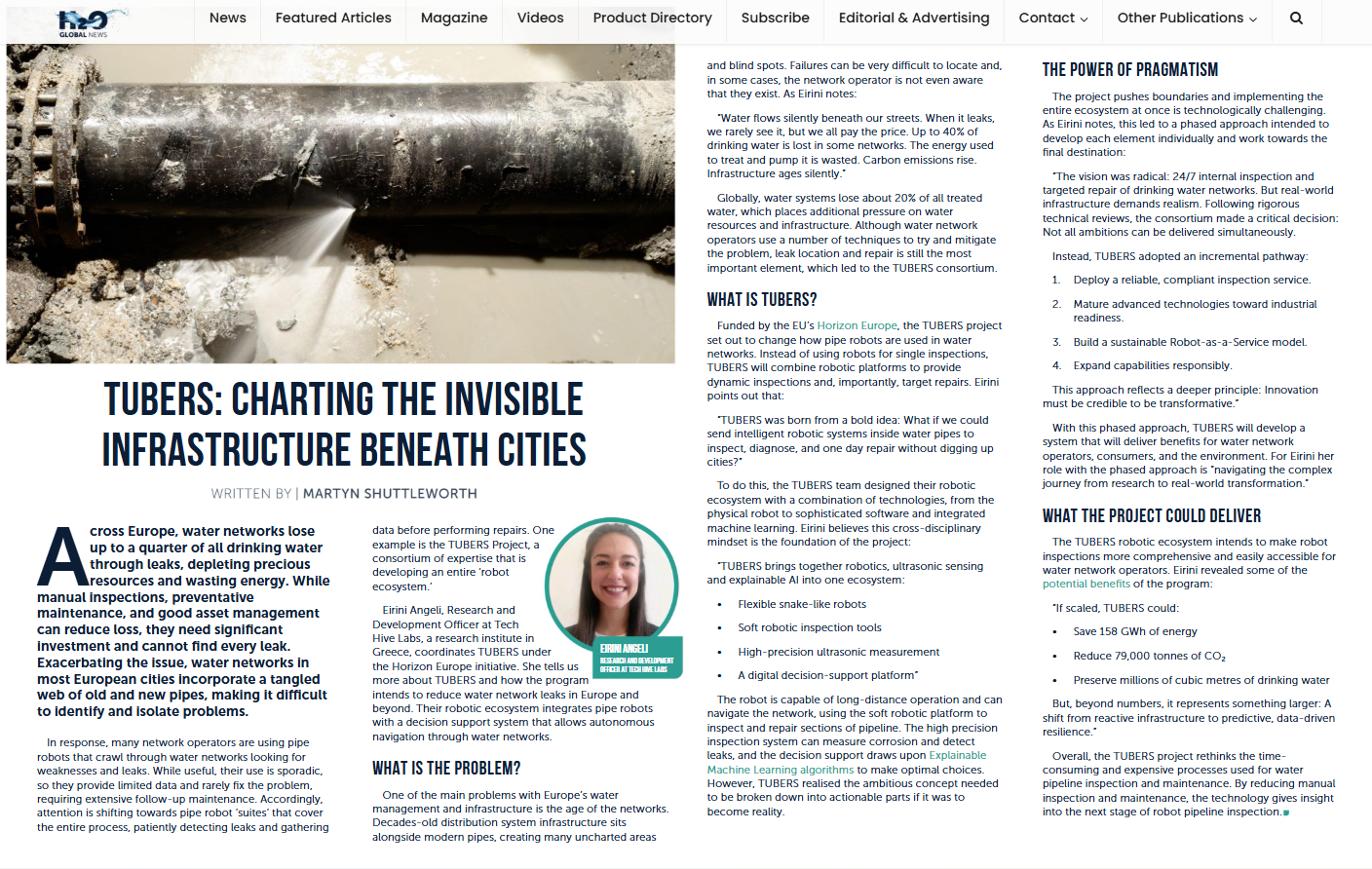
At its core, TUBERS is about helping operators move beyond reactive maintenance. By combining robotics, sensing and decision-support tools, the project aims to support a more targeted and evidence-based approach to pipeline management. That matters in a sector where buried infrastructure is difficult to access, failures can be costly, and traditional inspection methods often provide only partial visibility. Public project materials describe this wider ambition as reducing water losses, lowering operational burden, and improving long-term resilience in drinking water networks.
The magazine feature comes at a meaningful moment for the project. Recent TUBERS reporting shows continued progress in dissemination and communication, alongside technical advances across the project’s work packages. These include development and testing of the soft robotic system, continued maturation of the ultrasonic inspection setup, further work on machine-learning-supported defect analysis, and ongoing integration planning for field validation.
For TUBERS, visibility in sector-facing media is not just a communications milestone. It is part of a broader effort to connect research and innovation with the needs of utilities, industry stakeholders, and future adopters. The project’s dissemination strategy explicitly includes outreach through websites, newsletters, events, social media, and magazine-style publications in order to communicate benefits clearly to non-expert and professional audiences alike.
We are grateful to H2O Global News for helping spotlight the TUBERS vision and the wider importance of innovation in water infrastructure. Media coverage like this helps extend the conversation beyond the consortium itself and contributes to a stronger dialogue around what future-ready water network maintenance could look like.
As the project moves forward, TUBERS will continue sharing updates on its technologies, demonstrations, and lessons learned. The need for smarter, more sustainable pipeline inspection and repair is not going away, and collaboration across research, engineering, and utility operations remains essential to turning promising concepts into practical tools for the field.